
EKTAFAA CENTER FOR STATISTICS
From Charity to Clarity
Transforming Community Impact Through Research and Purpose.
A 12-month institutional transformation that repositioned Ektafaa from a charitable association into a specialized center for statistics and field research—helping organizations understand vulnerable communities and direct support where it is needed most.
CLIENT
Ektafaa Center for Statistics and Field Research
SECTOR
Social Statistics, Field Research & Community Development
PROJECT DURATION
12 Months
SERVICES
THE CHALLENGE
Ektafaa was evolving beyond the role associated with a traditional charitable organization. Its growing capability was centered on identifying vulnerable households, conducting field research, analyzing community needs, and producing reliable information for organizations responsible for social support.
However, its former name, positioning, and visual identity continued to define it primarily as a charity.
THE SOLUTION
Over 12 months, we helped Ektafaa redefine its institutional role. We developed its name architecture, clarified its service framework, built its brand strategy, and created a new visual identity and communication system that balance statistical credibility with a deep understanding of people and communities.
THE IMPACT
A clearer and more specialized brand that positions Ektafaa as a trusted source of field knowledge, capable of transforming household-level data into insights that support more accurate, responsible, and informed social decisions.

THE TRANSFORMATION
From Delivering Aid to Guiding Its Impact
Ektafaa began as a charitable association working close to families and communities experiencing financial and social hardship.
Through this work, the organization developed something increasingly valuable: direct knowledge of communities that are often difficult to understand through general statistics alone.
Its teams could enter underserved neighborhoods, communicate with households, document their circumstances, and identify differences between visible need and actual need.
Over time, this field capability became more than a supporting activity.
It became the organization’s most distinctive contribution.
Ektafaa could create value not only by delivering assistance, but by helping charitable, governmental, and social-development organizations understand where support was required, who should receive it, and what type of intervention could make the greatest difference.
The transformation therefore began with a fundamental question:
What if Ektafaa’s greatest impact was not limited to providing aid—but extended to improving how aid decisions are made?
The mission evolved.
From reaching families with support
to helping support reach the right families.

THE CHALLENGE
When the Old Category Limits the New Mission
The identity of Ektafaa Charity Association was connected to direct charitable work.
This created trust and familiarity, but it no longer represented the full scope of the organization’s developing capabilities.
Ektafaa was becoming a specialized research partner capable of conducting household surveys, documenting socioeconomic conditions, organizing field data, and producing reports that could support institutional decisions.
The existing brand created three challenges.
First, the organization could still be perceived as an aid provider rather than a source of research and evidence.
Second, its services were not structured in a way that allowed potential partners to understand exactly what Ektafaa could offer.
Third, its visual and verbal language did not yet communicate the accuracy, professionalism, confidentiality, and analytical depth expected from a statistics and research center.
The challenge was not simply to modernize the organization’s appearance.
It was to change how its role was understood.
Ektafaa had already developed a new capability.
The brand needed to make that capability visible.
THE STRATEGIC DECISION
A Center Built Around Evidence
The central strategic decision was to move Ektafaa into a clearly defined professional category: statistics and field research.
This direction gave the organization a more focused and valuable role within the social-impact ecosystem.
Rather than competing with charitable organizations in delivering assistance, Ektafaa could support them with the field evidence required to plan, prioritize, allocate resources, and evaluate need.
Its proximity to vulnerable communities became a strategic advantage.
Ektafaa understood that meaningful social data cannot always be collected from a distance. Reliable understanding requires entering communities, speaking directly with households, observing local conditions, verifying information, and treating every participant with dignity and confidentiality.
The new direction brought two worlds together.
The discipline of statistics and research.
And the human understanding created through responsible fieldwork.
Reliable data begins in the field.
Meaningful impact begins with understanding.
THE NAME
Keeping the Trust. Clarifying the Role.
The name Ektafaa already carried recognition, history, and a meaningful connection to the organization’s social purpose.
Removing it entirely would have meant losing valuable trust.
The naming process therefore focused on evolution rather than replacement.
“Ektafaa” was retained as the core name, while the former charitable designation was replaced with a more precise institutional descriptor:
Ektafaa Center for Statistics and Field Research.
The new name immediately clarifies the organization’s specialization. It allows potential partners to understand that Ektafaa conducts structured research, gathers field data, and produces statistical knowledge.
At the same time, the name preserves the human purpose behind the organization.
The goal is not data for its own sake.
It is knowledge that contributes to greater self-sufficiency, better social interventions, and more effective use of available resources.
A familiar name.
A newly defined institutional role.
THE SERVICE FRAMEWORK
From Fieldwork to Informed Decisions
One of the most important stages of the transformation was defining what Ektafaa offers and organizing its capabilities into a clear service framework.
The framework was designed around the complete journey of social information, from reaching households to producing usable knowledge.
HOUSEHOLD ENUMERATION:
Identifying and documenting households within defined neighborhoods or geographic areas according to approved research criteria.
NEEDS ASSESSMENT:
Studying household conditions and identifying economic, social, housing, educational, health, and other relevant needs.
FIELD SURVEYS:
Designing and conducting structured questionnaires, interviews, observations, and data-collection activities within targeted communities.
DATA VERIFICATION:
Reviewing, organizing, and validating collected information to improve its reliability before analysis and reporting.
STATISTICAL ANALYSIS:
Transforming field data into measurable findings, patterns, comparisons, classifications, and actionable insights.
REPORTS & DECISION SUPPORT:
Presenting findings through clear reports, dashboards, maps, and recommendations that help institutions plan and direct their resources.
This structure allowed Ektafaa to explain its services as one connected process rather than a collection of separate activities.
We do not stop at collecting data.
We turn what the field reveals into knowledge institutions can use.
THE BRAND STRATEGY
Understanding Society, Illuminating Insight
The brand strategy established the role Ektafaa should occupy in the minds of its partners.
Ektafaa is not simply a research office, a data collector, or a charitable organization operating under a new name.
It is a field-knowledge partner.
Its distinction comes from combining disciplined research methodology with direct access to communities and a practical understanding of social realities.
The strategy defined a brand built around four qualities.
ACCURATE:
Information must be collected, reviewed, and presented through clear and dependable methods.
HUMAN:
Every data point represents a person, a household, and a lived reality that must be treated with dignity.
INSIGHTFUL:
The value of data lies in revealing patterns, priorities, and implications that may not be immediately visible.
RESPONSIBLE:
Privacy, confidentiality, objectivity, and ethical field practices are essential to maintaining trust.
Together, these qualities created a brand that can communicate analytical confidence without losing its human character.
Precise enough to support decisions.
Human enough to understand their consequences.
THE POSITIONING
Closer to the Field. Clearer in the Findings.
Many institutions possess general information about communities.
Fewer possess verified, household-level knowledge collected directly from the field.
Ektafaa’s positioning was built around this difference.
The center works close to the communities being studied, enabling it to discover variations and needs that broader datasets may overlook.
This proximity is supported by a structured research process that turns observations and responses into organized, comparable, and usable evidence.
For charitable organizations, the findings can help improve beneficiary targeting.
For donors and foundations, they can clarify priorities and areas of need.
For governmental and social-development entities, they can support planning, resource allocation, program design, and impact assessment.
Ektafaa connects the reality of the neighborhood with the people responsible for making decisions.
Closer to people.
Closer to reality.
Closer to better decisions.
THE LOGO
A Symbol of Knowledge in Motion
The new logo was designed to reflect Ektafaa’s transformation into a confident, progressive, and research-led institution.
Its structured geometry communicates organization, measurement, and clarity.
The upward movement within the symbol suggests progress—the journey from raw information to understanding, and from understanding to more effective social outcomes.
The forms also create a sense of connection between separate data points, reflecting the center’s ability to bring individual household findings together into a wider view of the community.
The logo needed to perform across two very different environments.
It had to carry institutional credibility in research reports, presentations, agreements, and official communication, while remaining approachable during field visits and interactions with families.
The resulting mark gives Ektafaa a distinctive and contemporary presence without separating it from its social purpose.
From individual data points to a clearer direction forward.
THE VISUAL IDENTITY
Redesigning the Narrative
The visual identity needed to change the narrative surrounding Ektafaa.
It could no longer rely on the familiar visual conventions associated with charitable organizations. At the same time, adopting a purely technical or corporate appearance would have removed the human dimension at the heart of its work.
We therefore developed a visual system that balances analytical structure with social understanding.
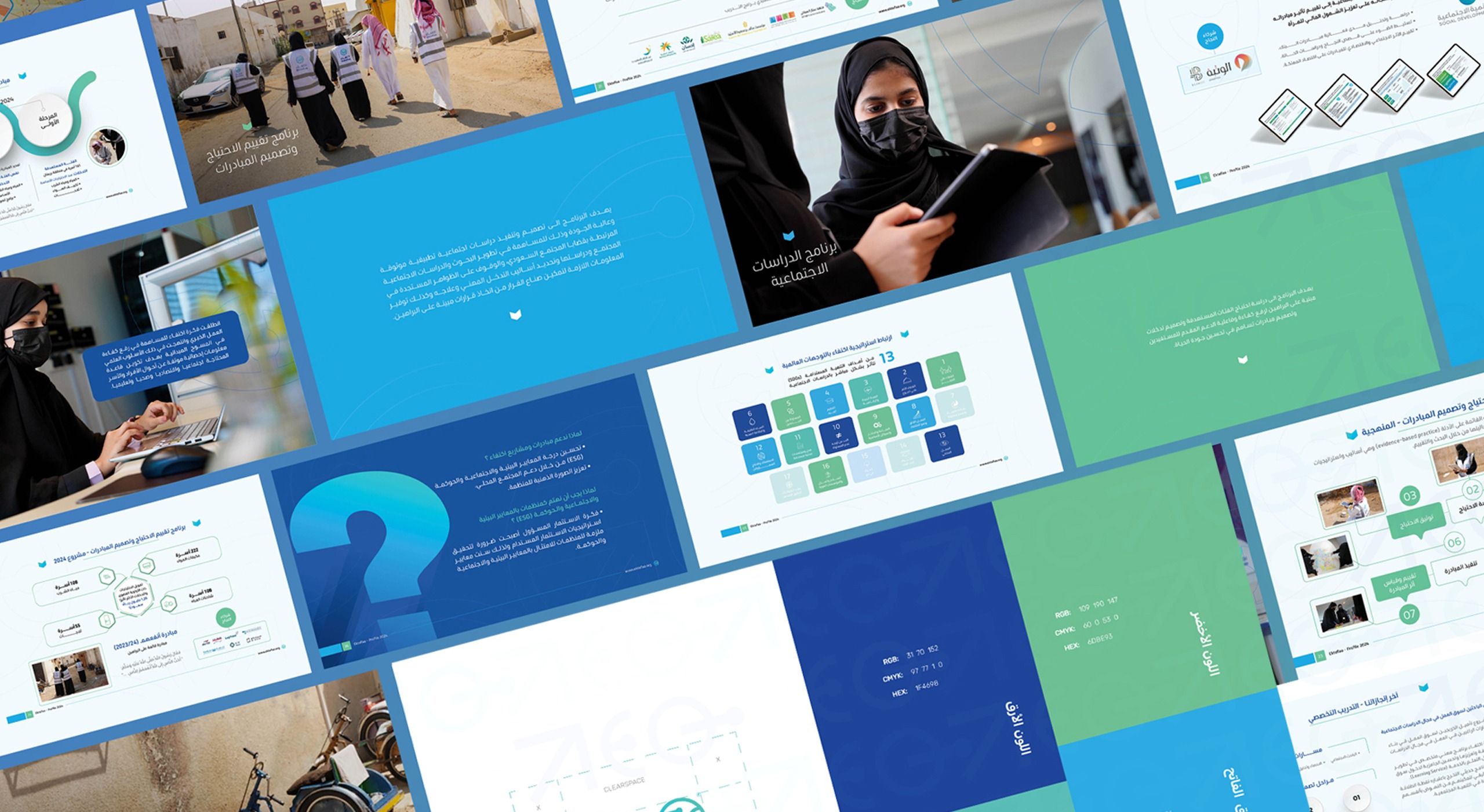
Clear grids and organized layouts reflect the discipline of research. Lines, directional forms, and modular compositions represent relationships, movement, and patterns within data.
The color palette establishes credibility and confidence, while brighter supporting colors introduce energy and make information more approachable.
Photography and content bring people and neighborhoods back into the system, ensuring that statistics are never presented as abstract numbers disconnected from real lives.
The identity allows Ektafaa to look rigorous without becoming distant—and socially aware without being perceived as a traditional charity.
A research identity with a human point of view.
DATA MEETS DESIGN
Making Complex Findings Easier to Understand
For a statistics and research center, design is not limited to expressing the brand.
It plays a practical role in making information usable.
Ektafaa’s visual system was extended into reports, data summaries, charts, maps, tables, presentations, survey documents, and executive findings.
A clear hierarchy helps readers move from the research question to the most important findings and then to the evidence supporting them.
Color coding differentiates themes, categories, locations, and levels of need. Consistent chart styles make comparisons easier, while structured page layouts allow detailed information to remain accessible.
The objective was not to decorate the data.
It was to remove unnecessary complexity and help decision-makers identify what matters.
Every report became an opportunity to demonstrate the center’s accuracy, professionalism, and ability to convert field information into clear knowledge.
Data becomes valuable
when people can understand what it is telling them.
THE FIELD EXPERIENCE
Trust Begins Before the First Question
Field research depends on more than well-designed questionnaires.
It depends on the relationship created between the researcher and the household.
Participants need to understand who is collecting their information, why it is being collected, and how it will be protected and used.
The identity was therefore extended into the complete field experience.
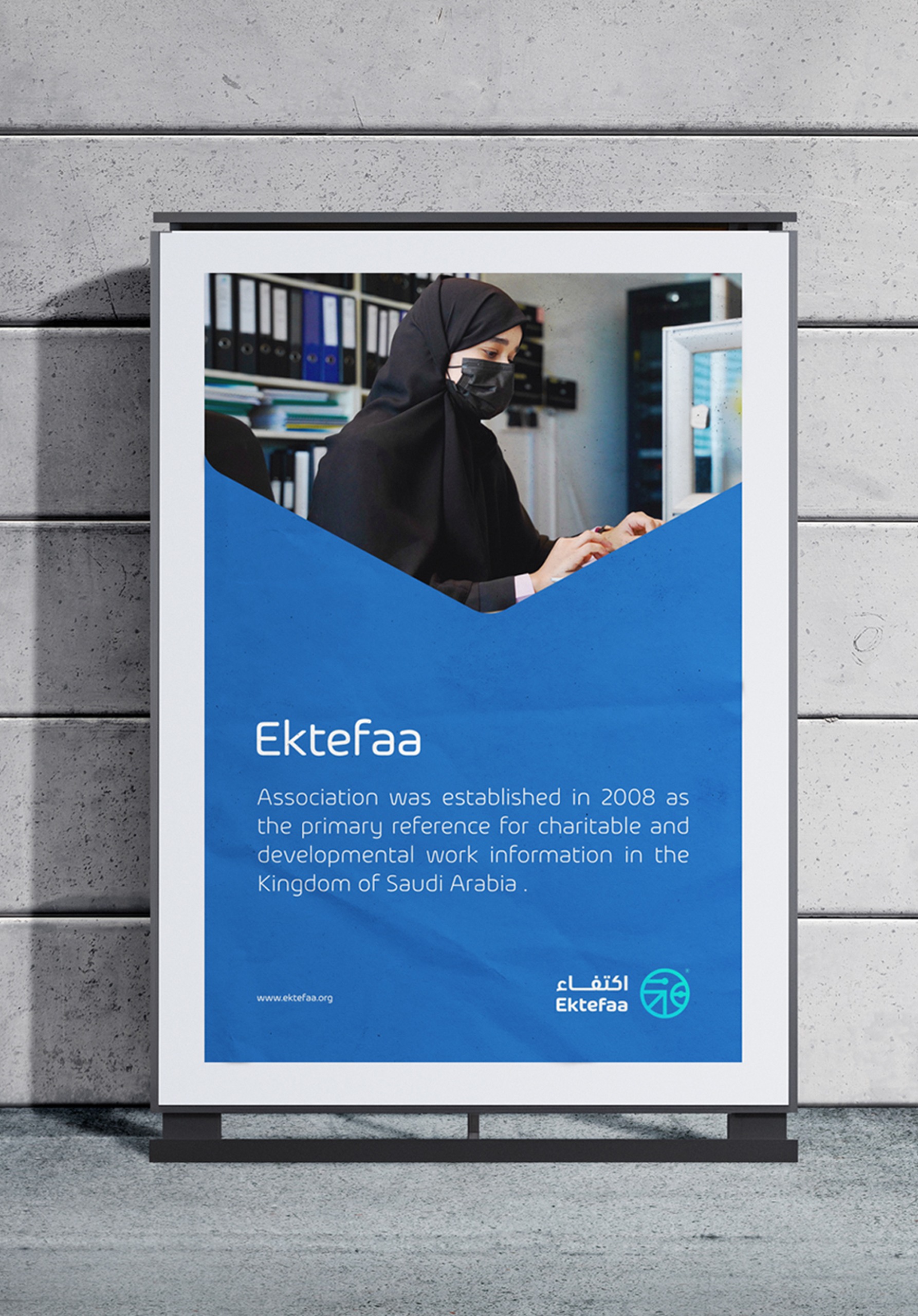
Researcher identification cards, uniforms, field folders, survey forms, tablets, introductory materials, consent documents, and vehicle applications create a more professional and recognizable presence.
Clear language helps researchers explain the study without creating confusion or unrealistic expectations.
A consistent appearance also helps families distinguish authorized field teams and feel more confident during the data-collection process.
In this context, branding becomes part of research quality.
It supports recognition, trust, transparency, and responsible interaction with every participating household.
Before people share their information,
they need to trust the people asking for it.
THE BRAND VOICE
A New Voice for Social Knowledge
Ektafaa required a verbal identity capable of communicating with institutions, researchers, field teams, and participating households.
The new voice was designed to be clear, respectful, evidence-led, and purposeful.
In institutional communication, it presents findings with confidence while avoiding exaggeration or unsupported conclusions.
In field communication, it uses direct and accessible language that helps participants understand the research and their role within it.
In reports and presentations, it explains complex information through structured messages and practical implications.
Across every audience, the voice avoids portraying vulnerable communities through pity or reducing households to numbers.
It communicates need with dignity and presents data as a tool for understanding—not a label placed on the people being studied.
Clear in what the data reveals.
Respectful of the people behind it.
BRAND GUIDELINES
Building Consistency into Every Finding
We developed comprehensive brand guidelines to ensure that Ektafaa could maintain a consistent identity across its institutional, research, field, and digital applications.
The guidelines define the correct use of the logo, colors, typography, graphic elements, photography, layouts, icons, data visualizations, and key applications.
They also establish practical rules for presenting information across reports, charts, tables, maps, presentations, questionnaires, and executive summaries.
This was especially important for an organization whose work may involve internal teams, field researchers, analysts, external partners, designers, and report-production suppliers.
The guidelines give everyone a shared system for representing Ektafaa accurately and professionally.
They protect both sides of the brand:
The institutional consistency required by a research center.
And the human sensitivity required by its field mission.
One system for every field visit,
every report, and every insight.
THE OUTCOME
A New Role in the Social-Impact Ecosystem
After 12 months of transformation, Ektafaa emerged with more than a new name and visual identity.
It gained a clearly defined institutional role.
The new service framework explains how the center moves from household enumeration and field research to analysis, reporting, and decision support.
The brand strategy positions Ektafaa as a trusted partner for organizations that need a deeper and more accurate understanding of vulnerable communities.
The visual identity gives this role a credible and recognizable presence across the field, the meeting room, and the research report.
Most importantly, the transformation gives greater purpose to Ektafaa’s proximity to communities.
The knowledge gathered through every visit can now contribute to better targeting, more informed programs, and more responsible allocation of social resources.
Ektafaa is no longer defined only by the assistance it can provide directly.
It is defined by the clarity it can provide to everyone working to create social impact.
Better knowledge.
Better decisions.
Better-directed impact.
Let’s Give Meaning to Your Mission
Real transformation is not achieved by changing how an organization looks.
It begins by clarifying the role it should play, the value it can create, and the people it exists to serve.
At Tnween, we develop names, strategies, service frameworks, and visual identities that help organizations move into their next chapter with clarity and purpose.
